UNDP, Norway : Holds Competition for EPPIC in the Indonesian Marine
UNDP (United Nations Development Programme) with the Ministry of Foreign Affairs of Norway and NORAD (Norwegian Agency for Development Cooperation) held a marine waste management competition again in Indonesia. The competition, entitled EPPIC (Ending Plastic Pollution Innovation Challenge) phase 2, is a continuation of the previous EPPIC, which focuses on ASEAN countries.
The first phase of EPPIC was held last year, focusing on Ha Long Bay Vietnam and Koh Samui Thailand, for the second phase will be implemented by focusing on Indonesia and Philippines.
The aim of the EPPIC competition is to provide a pathway for the latest innovative solutions that can have real implications and be able to contribute to society not only environmentally, but also economically and socio-culturally.
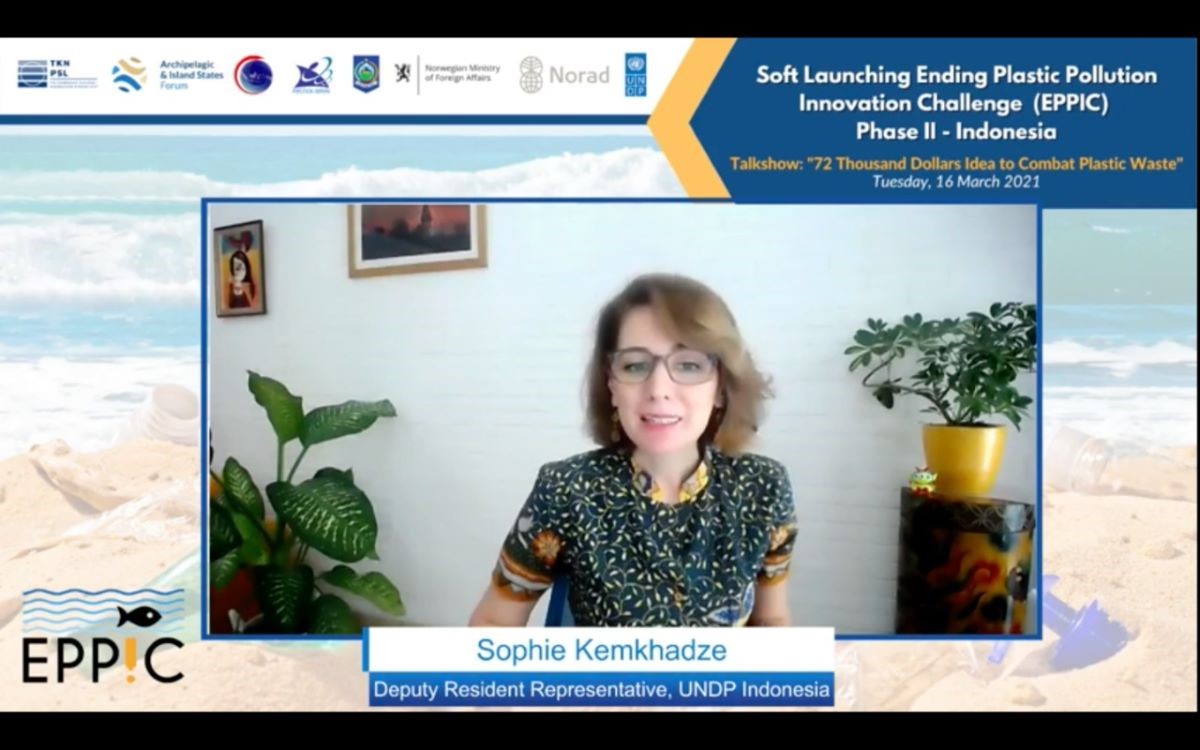
Sophie Kemkhdaze, as Deputy Resident Representative of UNDP Indonesia said, “Based on other studies, it shows that Southeast Asia is the region with the largest contribution to plastic leakage in the marine. UNDP hopes that EPPIC can contribute to decrease this number through the emergence of innovative solutions, their development and replication.”
Research from the Indonesian Institute of Sciences (LIPI) states that around 268,740 – 594,558 tons of plastic waste are leaking into Indonesia’s marine every year. The Oceanographic Research Center of LIPI estimates that the rough potential value of Indonesia’s marine until March 2019 is worth 1,772 trillion. The large potential value of the marine then makes Indonesia have to pay specific attention to the marine conditions.
“From the previous 2020 EPPIC in Vietnam and Thailand, we already saw solutions from private companies, NGOs, and the academia originating in many ASEAN countries. This year, we will see contributions targeting Indonesia and the Philippines. It will increase the power of the ASEAN region, ASEAN’s region multilateral partnership, as we tackle these issues in Southeast Asia,” Kemkhdaze concluded.
Novrizal Tahar, Director of Waste Management, KLHK (Ministry of Environment and Forestry of the Republic of Indonesia) as well as Secretary of the National Action Plan for Marine Waste Management said, “The Indonesian government has taken steps to reduce waste and plastic pollution from upstream to downstream. We certainly really appreciate the EPPIC program. The problem related to waste has been a problem not only faced by Indonesia or ASEAN, but also throughout the world. This has been proven by including this issue in one of the number 14 sustainable development goals, Life Below Water, which surely become the focus of the Indonesian government as an archipelagic country that is surrounded by the sea. “
Plastic pollution has become a big problem for the world and Indonesia. Until now, Indonesian people are still very dependent on the use of plastic, both as food wrappers and as shopping bags. This happens because plastic is an option that is relatively cheap and easy to obtain so that it can reduce production costs.
Apart from habitual factors, another factor that is quite influential in managing plastic pollution is the difficulty in the process of decomposing plastics. It is difficult for plastics to decompose naturally; as a result plastic waste tends to remain in the same condition and content over a very long period of time.
EPPIC hopefully will raise innovations that can help to tackle the problem of plastic pollution, provide an economic boost, and foster public understanding of the dangers and impacts of plastic pollution for human and biological survival. *BTNewspaper/e/undp