Putting People and MSMEs, Centre of Recovery
Bali, BTNp: UNWTO, the G20 Indonesian Presidency and the G20 Tourism Working Group have collaborated over the past year to deliver the G20 Guidelines on Strengthening MSMEs and Communities as Agents of Transformation in Tourism on the occasion of the G20 Tourism Ministers Meeting in Bali.
The Guidelines provide guidance for key policies that can create resilient and sustainable MSMEs and communities spanning five key pillars:
- Human Capital
- Innovation, digitalization and the creative economy
- Women and youth empowerment
- Climate action, biodiversity conservation, circularity, and
- Policy, governance and investment
They also drew up over 40 cases studies from G20 members and guest countries focused on the promotion of MSMEs and communities
Accelerating Positive Action
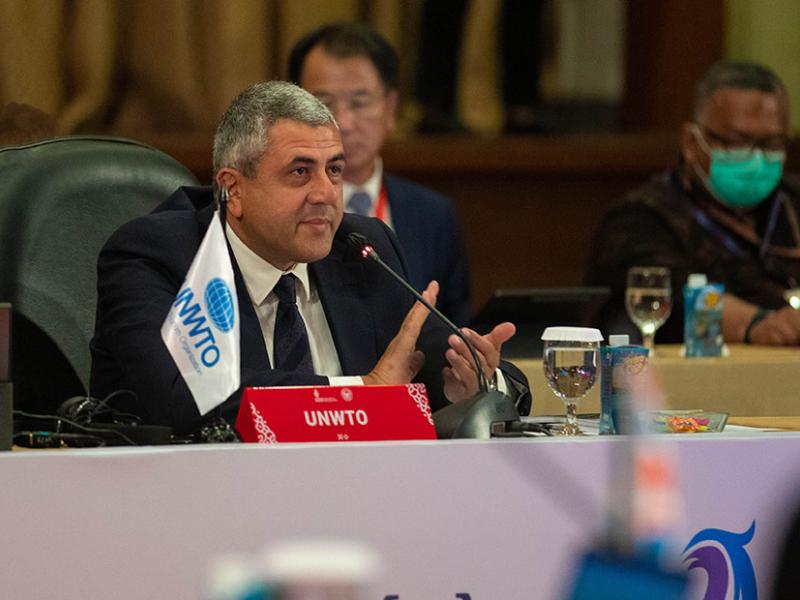
Addressing the G20 Tourism Ministers Meeting, UNWTO Secretary-General Zurab Pololikashvili said that the tourism sector has now recovered almost 60% of pre-pandemic levels.
“We are falling behind in our efforts to reach the climate action goals of the Paris Agreement. We are also behind in progress toward the Sustainable Development Goals. Tourism can help us get back on track. But we need to speed up. And we need to scale up. MSMEs and communities, the backbone of our sector, need strong support to be agents of a people-centred transformation” he added.
G20 Tourism Working Group is able to adopt the G20 Bali Guidelines, and embody a number of policy best practices in the five main lines of action. The Guidelines focus among others on:
- developing targeted policies based on social dialogue and multi-stakeholder collaboration to promote vocational education and training, skills development, and lifelong learning of the tourism workforce by engaging industry and technology partners;
- stimulating entrepreneurship including through tourism business incubation and promoting the creation of decent jobs in tourism;
- strengthening linkages between the tourism sector and local communities by encouraging partnerships with local suppliers;
- bridging the innovation gap and promoting responsible innovation;
- developing guidance for MSMEs to enable them to tap into digitalization, improve their products and boost their productivity through the creative economy;
- ensuring equality and non-discrimination, with particular attention to young people in vulnerable situations, promoting the application of gender equality and equal opportunity principles for all youth in tourism including equal remuneration for work of equal value, equal participation and equal treatment;
- implementing, within respective national policy, more sustainable and environmentally friendly practices; and
- Improving tourism data, including the use of big data, the implementation of international statistical standards and the development of adequate methodology for Measuring the Sustainability of Tourism as evidence-based policy-making as well as facilitating data sharing including through public-private partnerships.
Research developed for the guidelines by UNWTO with G20 countries highlights the need to address challenges for MSMEs of lack of access to finance, lack of access to market intelligence, market uncertainty, the volatility of the workforce, changing consumer trends and needs and low levels of innovation.
For communities, the most relevant challenges include the uncertainty of the market and changing consumer trends, leakages (revenue generated by tourism in the community which does not stay in the community), lack of education and skills, lack of adequate infrastructure and governance and excessive dependence on tourism. *BTNewspaper/Erviani