ASEAN Aligns Investments Around Eight Sustainable Resilience Pillars
TANGERANG, BTNp: INDONESIA’s National Board for Disaster Management (BNPB), in collaboration with the ASEAN Secretariat and the Australian Government through the SIAP SIAGA Program. Reaffirmed its commitment to strengthening regional resilience through eight core strategic pillars for the 2026–2035 period.
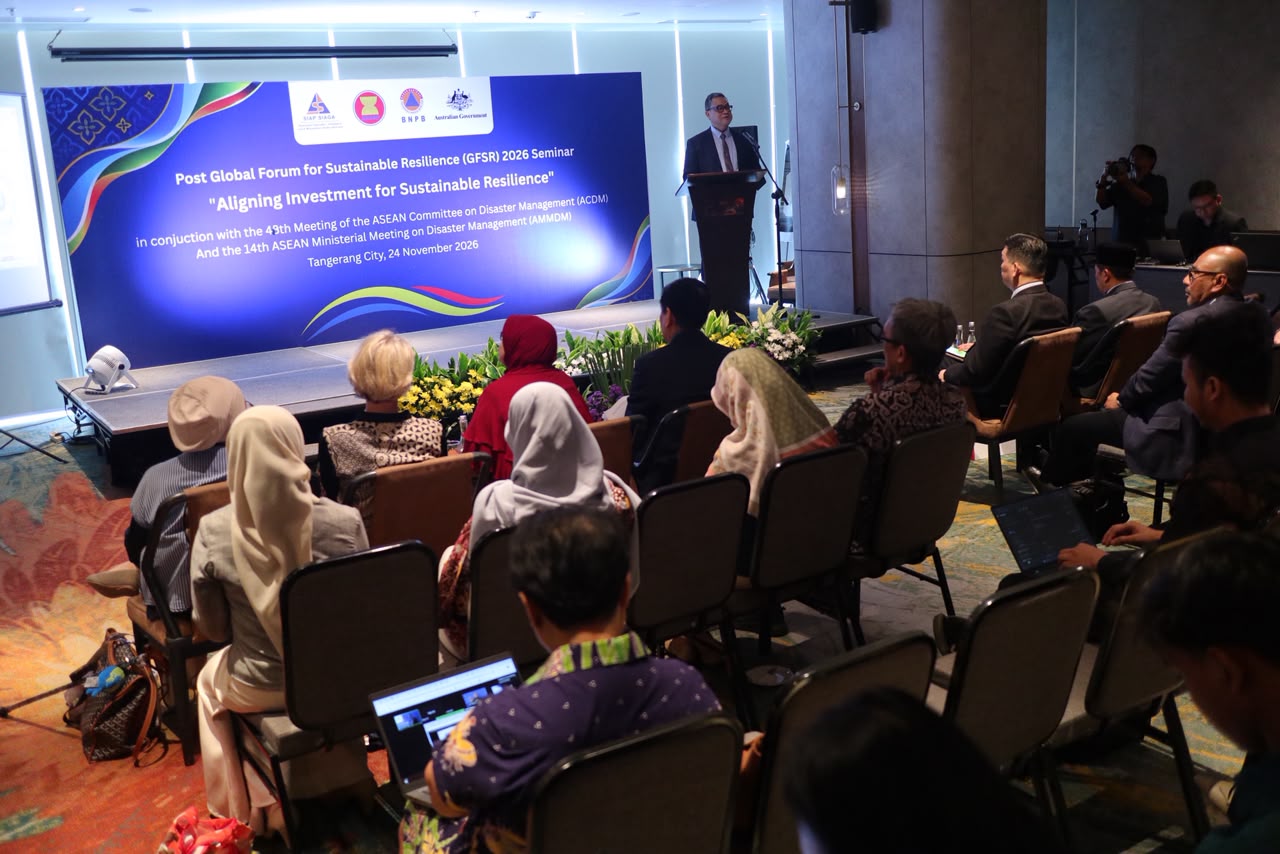
The framework is designed to integrate disaster risk reduction (DRR), climate action, and sustainable development into a unified approach. This strategic direction was highlighted during the Post Global Forum for Sustainable Resilience (GFSR) 2026 seminar, themed “Aligning Investment for Sustainable Resilience,” held in Tangerang City, Banten, on Tuesday (24/11). Convened alongside the 49th Meeting of the ASEAN Committee on Disaster Management (ACDM) and the 14th ASEAN Ministerial Meeting on Disaster Management (AMMDM), the forum aims to break down cross-sectoral silos in regional disaster governance.
BNPB Deputy for Systems and Strategy, Dr. Raditya Jati, explained that the eight pillars were formulated from lessons learned from past disasters as well as development dynamics closely intertwined with climate change, which carry the potential to generate new and compounding risks.
The eight strategic pillars for ASEAN Sustainable Resilience 2026–2035 encompass:
-Risk intelligence and hazard assessment, including early detection of threats and vulnerabilities.
-Prevention, mitigation, and climate adaptation, to reduce risks prior to and during hazard events.
-Community resilience and inclusive action, focusing on protecting vulnerable groups and empowering local citizens.
–Resilient infrastructure and sustainable recovery.
-Risk financing and resilient economy.
-Science, technology, innovation, and industrialization.
-Preparedness, response, and humanitarian cooperation.
-Governance, partnership, and regional leadership.
Two Top Priorities
Among the eight pillars, Raditya identified risk financing and resilient economy alongside science, technology, innovation, and industrialization as the two most urgent priorities requiring immediate acceleration.
“The main challenge lies in how we finance all these activities and position financing prior to disaster occurrences so that resilience is built sustainably,” said Raditya Jati during his presentation.
Beyond pre-disaster funding, Raditya underscored the importance of self-reliance in disaster science, technology, and industrialization. This step is crucial to ensure Indonesia and ASEAN Member States do not remain dependent on foreign technology supplies, but instead develop homegrown innovations to meet domestic and regional needs.
Cross-Sectoral Synergy and Monitoring Mechanisms
The joint hosting of the forum with the ASEAN Secretariat and the Australian Government via the SIAP SIAGA Program, also reflects tangible development partner collaboration in driving inclusive resilience investments across Southeast Asia.
To prevent the eight pillars from operating in silos across ministries/agencies or ASEAN Member States between 2026 and 2035. Raditya stressed the need for shared commitment through a whole-society approach and an all-government approach. He noted that disaster management cannot rest on a single sector alone, as it directly intersects with health, education, infrastructure, and the economy.
“What matters most is how existing regulations are translated into clear, actionable, and measurable planning,” Raditya stated.
At the national level, resilience progress is monitored under Presidential Regulation (Perpres) No. 87 of 2020 on the Master Plan for Disaster Management. These achievements are consolidated into the evaluation of the Government Work Plan (RKP) and the National Medium-Term Development Plan (RPJMN) alongside the Ministry of National Development Planning (Bappenas) and the Ministry of Home Affairs. And are reported annually to the President to support national resilience toward Golden Indonesia 2045.
ASEAN Regional Policy Integration
The 2026–2035 framework simultaneously bridges the five-year tactical plans of the ASEAN Vision 2045 and post-2030 global policy continuity. Its implementation is supported by key strategic instruments, including:
-Utilization of the ASEAN Disaster Resilience Platform (ADRP) across 13 ASEAN sectoral bodies.
-Alignment of investments with the ASEAN Taxonomy for Sustainable Finance.
-Implementation of resilience budgeting—domestic budget tagging related to DRR and climate action without creating new centralized funds or diminishing national fiscal autonomy.
-Strengthening of pentahelix innovation networks through the ASEAN Sustainable Resilience Initiative (ASRI).
Through investment alignment and the operationalization of these eight pillars, BNPB aims to deliver tangible, sustainable resilience for the people of Indonesia and the wider ASEAN region in facing complex, multi-layered risks ahead. *BTNewspaper